Community Jun 6, 2026
by FIA Admin
You Don't Need a Charity to Change the World
The idea that for-profit companies exist only to make money, and nonprofits exist to do good, is one of the most limiting lies we've inherited. It's time to challenge it
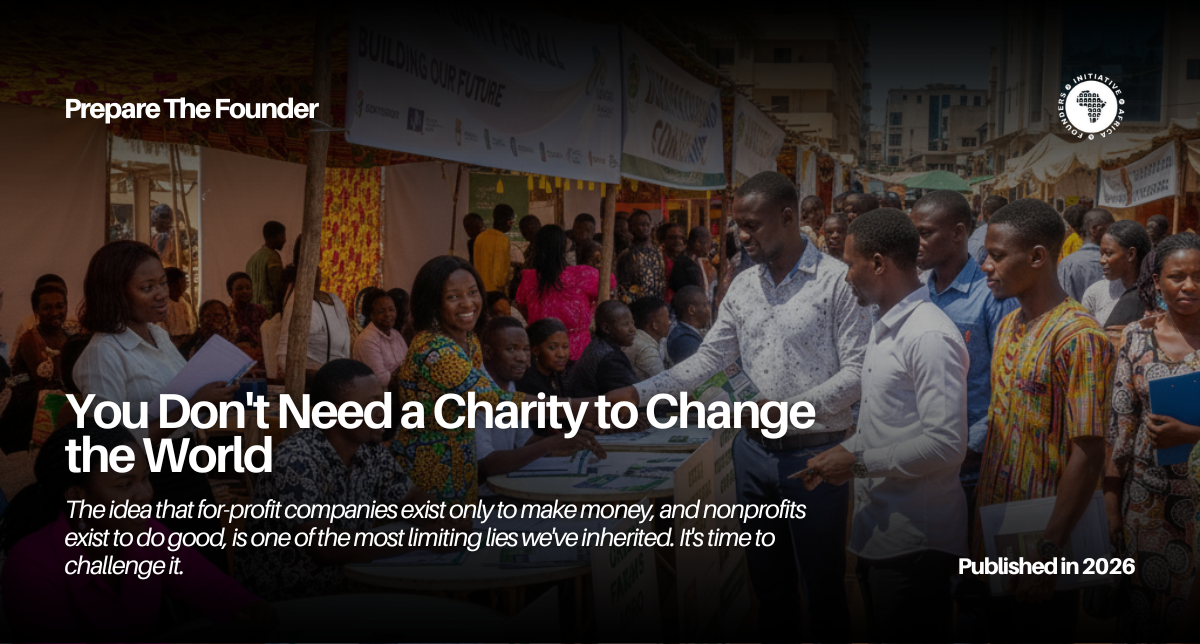
The idea that for-profit companies exist only to make money, and nonprofits exist to do good, is one of the most limiting lies we've inherited. It's time to challenge it.
There's a story we've been told about business, it goes like this: if you want to make money, build a company. If you want to do good, start a foundation. The two live in separate worlds, funded differently, measured differently, respected differently.
I don't believe that story anymore. And honestly, I think it's kept a lot of young African builders from understanding the real power they hold.
The nonprofit halo is misleading
Nonprofits do important work. Nobody should take that away from them. But the way we've romanticized them, as the only legitimate vehicle for social impact has created a dangerous assumption: that a business chasing profit is by nature self-serving.
Think about it. When a young person says "I want to help my community," what do we imagine? Probably a charity, a grant, a fundraiser. Rarely do we picture someone building a company, hiring from the local area, solving a real problem, and generating wealth that stays in the community. But that second picture is often the more durable one.
"A nonprofit can feed a village for a season. A well-built for-profit business can employ that village for a generation."
Profit is not the opposite of purpose
The most dangerous word in this conversation is "just." As in — "they're just trying to make money." As if making money is a shallow thing. As if Paystack, Flutterwave, or Andela were just trying to make money when they solved real infrastructure problems for millions of Africans.
Profit is a signal. It means people value what you built enough to pay for it. It means you can keep building. It means you can hire, expand, and compound your impact in ways that no grant cycle can match.
A nonprofit runs on goodwill and donor schedules. A profitable company runs on demand, which is a much more reliable engine.
Three ways for-profit companies contribute more than people realize
Employment
Every hire you make is a family supported. Wages are one of the most direct wealth transfers in any society.
Infrastructure
Businesses build roads (metaphorically and sometimes literally). They solve logistics, access, and distribution problems governments ignore.
Access
When a for-profit brings a service to an underserved market e.g. fintech, edtech, healthtech, it creates access that aid organizations rarely sustain.
The African context makes this even more urgent
Here on this continent, we've had decades of NGO presence. Billions of dollars in aid. And while some of it has done real good, a lot of it has also created dependency, distorted local markets, and discouraged local entrepreneurship.
What Africa actually needs is not more foreign charity. It needs more homegrown companies solving homegrown problems at scale. It needs founders who understand the terrain, speak the language, and have skin in the game.
You, building a business right now, are doing something more politically powerful than most nonprofits will ever accomplish. You are proving that Africans can build, own, and sustain solutions. That is not a small thing.
"Dependence is not dignity. Building something that sustains itself ,and others is."
But it does require intentionality
None of this is an excuse to build a for-profit company that underpays its workers, dodges taxes, and exploits its customers, that is not contributing to society, you are mining it. The point is not that for-profits are automatically good. It's that they can be, and many already are, when built with intention.
Ask yourself: Who do I hire? How do I pay them? What problem am I actually solving and for whom? Do the people my company touches leave better or worse than when they arrived?
Those questions don't belong only to nonprofits. They belong to every founder who claims to care about something beyond themselves.
So what does this mean for you?
If you're a young African building a business right now, I want you to carry this: you don't have to choose between ambition and impact. The best businesses are the ones where those two things are not in tension, they're the same engine.
Build something profitable. Build something that lasts. Build something that your community looks at in ten years and says, that company changed things around here. Not because they handed out food baskets. Because they built something worth staying for.
The nonprofit model is one way to serve. The for-profit model done right, is another. Both matter. But only one of them scales without needing someone else to fund it.